
Vitamin D3 is one of the most researched micronutrients in the world, and low vitamin D status is common on every continent. Large randomised trials published since 2022 have sharpened the picture: who benefits most, which doses make sense, and where expectations should be tempered. Here is a concise overview for physicians, pharmacists and nutrition professionals.
Key takeaways
- Worldwide, almost half of all people have vitamin D levels below 50 nmol/l, according to a 2023 analysis of 7.9 million participants in 81 countries. Sunny regions are not exempt.
- The strongest recent signals come from people with low starting levels. Trials in well-supplied populations often show little effect.
- Daily, moderate doses are now preferred over occasional very high doses.
- Both the US National Academies and the European Food Safety Authority set the safe upper limit for adults at 4,000 IU (100 µg) per day. Maximum doses allowed in supplements still differ from market to market.
Why vitamin D3 matters
Vitamin D is unusual: the body makes most of it in the skin when exposed to UVB light. Far from the equator, the winter sun is too low for meaningful synthesis for several months each year. Closer to the equator, indoor lifestyles, covering clothing, darker skin, sunscreen and air pollution all reduce how much vitamin D the skin makes, so intake from food and supplements matters almost everywhere. Vitamin D3 (cholecalciferol) is the form the body produces itself and the form used in most supplements.
Its core roles are well established. In the European Union, for example, the following health claims are authorised under Regulation (EU) No 432/2012. Vitamin D contributes to:
- the normal absorption and utilisation of calcium and phosphorus, and normal blood calcium levels
- the maintenance of normal bones, teeth and muscle function
- the normal function of the immune system
- the process of cell division
How common is low vitamin D worldwide?
The largest pooled analysis so far, published in Frontiers in Nutrition in 2023, combined 308 studies with 7.9 million people in 81 countries. Globally, 15.7% had levels below 30 nmol/l (deficiency), 47.9% below 50 nmol/l and 76.6% below 75 nmol/l.
- Middle East and North Africa: the highest burden, despite abundant sunshine. In the WHO Eastern Mediterranean Region, 71.8% of people were below 50 nmol/l and 35.2% below 30 nmol/l.
- Europe: 53% below 50 nmol/l and 18% below 30 nmol/l, with strong seasonal swings.
- Africa: the lowest share below 50 nmol/l (18.9%), but more than half of people (55.3%) are still below 75 nmol/l.
- The Americas: the lowest rate of severe deficiency (5.5% below 30 nmol/l), helped by widespread food fortification.
Low levels were 1.7 times more common in winter and spring than in summer and autumn, and more common in women than in men. For clinicians, this means low vitamin D status should be considered in every region, not only at high latitudes.
What recent research shows
1. Biological ageing: a first signal from VITAL (2025)
A four-year sub-study of the US VITAL trial, published in the American Journal of Clinical Nutrition in May 2025, followed 1,054 adults aged 50+. Those taking 2,000 IU vitamin D3 daily showed significantly less shortening of their telomeres (the protective ends of chromosomes) than the placebo group. The researchers estimated this as the equivalent of nearly three years of biological ageing. Omega-3 alone had no effect. The authors stress that confirmation is needed.
2. Autoimmune conditions: 22% fewer new cases (BMJ, 2022)
In the full VITAL trial with 25,871 older adults, 2,000 IU vitamin D3 daily over about five years was associated with a 22% lower rate of newly diagnosed autoimmune diseases such as rheumatoid arthritis and psoriasis, compared with placebo.
3. Heart events: a cautious signal (D-Health, BMJ, 2023)
The Australian D-Health trial gave more than 21,000 adults aged 60–84 a monthly dose of 60,000 IU for up to five years. Major cardiovascular events were 9% lower and heart attacks 19% lower than with placebo. The overall result was not statistically conclusive, and the investigators call for further research.
4. Type 2 diabetes risk (Nature Communications, 2025)
A VITAL analysis of more than 22,000 adults found no significant effect of 2,000 IU/day on its own. When combined with three other trials in a meta-analysis, vitamin D was linked to an 11% lower risk of developing type 2 diabetes, mainly in people without obesity.
5. Why many trials look “neutral” (Clinical Nutrition, 2026)
Researchers from the German Cancer Research Center (DKFZ) re-created the VITAL and D-Health trials using UK Biobank data. In people with adequate levels, they found no effect on mortality, as in the original trials. In people who started with low levels, however, the estimated mortality risk was 15–25% lower. Their conclusion: trials run mostly in well-supplied people were always likely to show little effect, and future studies should focus on those with low vitamin D status.
Where expectations should be realistic
Not every outcome improves. In VITAL, 2,000 IU/day did not reduce fractures in generally healthy older adults who were not selected for deficiency (New England Journal of Medicine, 2022). Vitamin D works best when it closes a real gap. It is not a cure-all.
What current guidelines recommend
- US National Academies (Institute of Medicine): 600 IU (15 µg) per day for people aged 1–70 and 800 IU (20 µg) from 71, with a safe upper limit of 4,000 IU (100 µg) per day for adults.
- Endocrine Society (2024): no routine blood testing for healthy adults. Supplementation above standard intakes is suggested for children and adolescents, pregnant women, adults over 75 and adults at high risk of prediabetes. Daily dosing is preferred over large intermittent doses.
- European Food Safety Authority (2023): a tolerable upper intake level of 100 µg (4,000 IU) per day for adults, including pregnant and breastfeeding women, and adolescents from 11 years; 50 µg per day for children aged 1–10.
- National rules differ: maximum amounts per daily dose in supplements are set nationally. Germany’s Federal Institute for Risk Assessment (BfR), for example, recommends no more than 20 µg (800 IU) per daily dose, while other markets, including the United States, permit considerably higher-strength products.
Implications for practice
- Focus on people at risk. The evidence for benefit is strongest in people with low baseline status: older adults, people with little sun exposure, darker skin or covering clothing, obesity or malabsorption, and pregnant women. Routine testing of healthy adults is not recommended (Endocrine Society, 2024).
- Prefer daily dosing. Daily doses of 800–2,000 IU (20–50 µg) are consistent with recent trials and guidelines. Large intermittent bolus doses are no longer preferred.
- Respect upper limits. 4,000 IU (100 µg) per day for adults unless prescribed and monitored. National limits for over-the-counter products may be lower.
- Choose a format that supports adherence. Oil-based softgels or drops suit long-term use; drops suit infants and children. Combinations with vitamin K2 or calcium can be considered where clinically appropriate.
- Set realistic expectations. Vitamin D is not a fracture-prevention strategy for healthy, replete adults. Its benefit lies mainly in correcting a deficit.
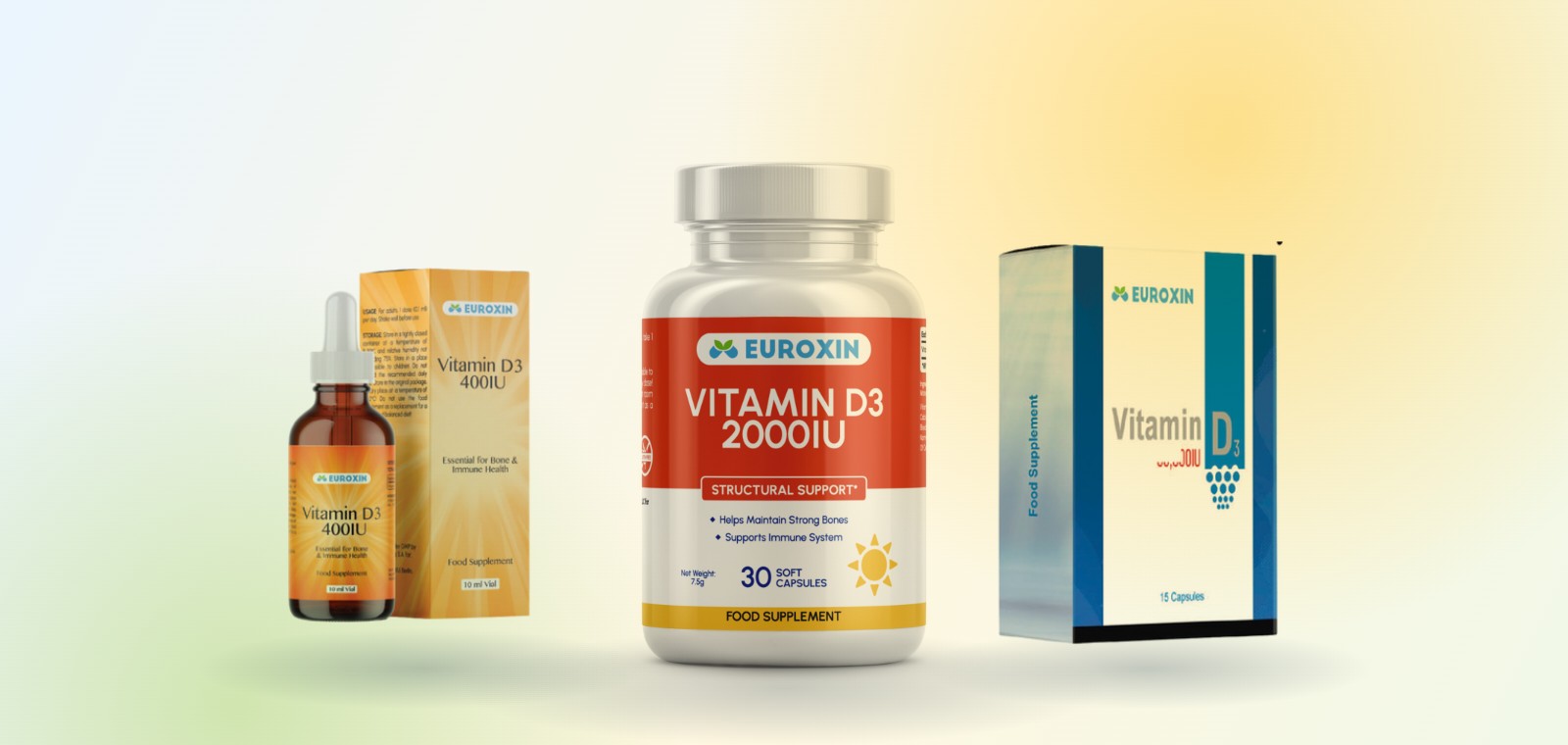
Euroxin offers vitamin D3 in several formats and strengths. Product specifications and certificates of analysis are available to healthcare professionals on request. Contact us or see our products.
Note: This article summarises published research for healthcare professionals. It does not replace clinical judgement or official guidelines and does not make health claims for any specific product.
Sources
- Zhu H. et al. Vitamin D3 and marine ω-3 fatty acids supplementation and leukocyte telomere length: 4-year findings from the VITAL randomized controlled trial. Am J Clin Nutr, 2025. Abstract · Mass General Brigham summary
- Hahn J. et al. Vitamin D and marine omega 3 fatty acid supplementation and incident autoimmune disease: VITAL randomized controlled trial. BMJ, 2022. Harvard Gazette summary
- Thompson B. et al. Vitamin D supplementation and major cardiovascular events: D-Health randomised controlled trial. BMJ, 2023. BMJ
- Tobias D.K. et al. Vitamin D supplementation vs. placebo and incident type 2 diabetes. Nature Communications, 2025. Nature Communications
- Wang Y., Schöttker B., Brenner H. et al. Impact of vitamin D supplementation on all-cause mortality: randomized trials revisited. Clinical Nutrition, 2026. ScienceDirect
- LeBoff M.S. et al. Supplemental vitamin D and incident fractures in midlife and older adults. N Engl J Med, 2022. NEJM
- Demay M.B. et al. Vitamin D for the prevention of disease: an Endocrine Society clinical practice guideline. J Clin Endocrinol Metab, 2024. Healio summary
- EFSA NDA Panel. Scientific opinion on the tolerable upper intake level for vitamin D. EFSA Journal, 2023. EFSA
- Federal Institute for Risk Assessment (BfR). Updated maximum level proposals for vitamin D in foods including food supplements, 2023. BfR (PDF)
- Cui A. et al. Global and regional prevalence of vitamin D deficiency in population-based studies from 2000 to 2022: a pooled analysis of 7.9 million participants. Front Nutr, 2023. Frontiers in Nutrition
- Institute of Medicine (National Academies). Dietary Reference Intakes for Calcium and Vitamin D, 2011. National Academies
- Commission Regulation (EU) No 432/2012 establishing a list of permitted health claims. EUR-Lex